

Marble Works for Architects: Tables, Consoles and Vanities in Natural Stone
Marble works for architects and interior designers have to deliver more than a good photograph. A project needs reliable dimensions, a clear statement on stone type and finish, a weight that structural engineers and logistics teams can work with, and a delivery date that fits the site programme. Since 2007, Casa Padrino has supplied marble furniture and objects from Essen to hotels, restaurants, villas, apartments and boutiques: dining tables and coffee tables with marble tops, console tables, vanities and washbasins, fountains, vases and busts.
This page sets out what matters when you specify natural stone: which marble suits which use, how polished and honed surfaces behave in daily operation, what a slab weighs, how sealing and maintenance work in a hotel, and how an enquiry runs from floor plan to delivery. Many pieces are made to measure on request, in the quantity your project calls for, and shipped worldwide by freight forwarder.
Marble pieces for hospitality and residential projects
In a well planned building, marble is not a single decorative corner but a material that can run from the restaurant to the bathroom. Deciding early where natural stone will appear allows stone type and finish to be coordinated across all spaces. The most common applications:
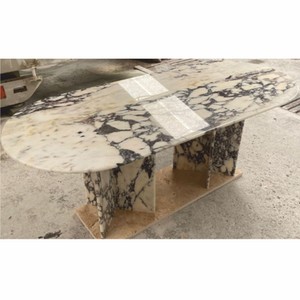
- Marble dining tables for restaurants, breakfast rooms, suites and villas, rectangular, oval or round. Background and examples on the page Marble Dining Table.
- Coffee tables and side tables in real marble for lobby, lounge, bar and the living areas of suites.
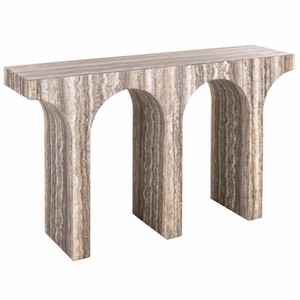
- Console tables for entrance halls, corridors, lift lobbies and reception, see Marble Console Table.
- Vanities and vessel basins for guest bathrooms, suites, spa and public washrooms, see Washbasins and Washing Tables.
- Fountains for courtyards, gardens, terraces and wellness areas, see Fountains and Water Columns.
- Vases and busts as accents in halls, libraries, stairwells and galleries.
An overview of the whole material family is given on Marble Furniture by Casa Padrino. Marble fireplace surrounds and columns have their own pages, because installation and fire safety play a separate role there; a first introduction is the page Marble Fireplace Mantel.
Stone types: character, effect and best use
Marble is a collective term for many stones that behave quite differently. For specification purposes it is enough to know the main groups and match their strengths to each space.
- Carrara white: white to pale grey ground with fine grey veining. Timeless, bright and calm. Red wine, coffee or oil show more readily on white stone than on dark, so a good sealer is particularly important.
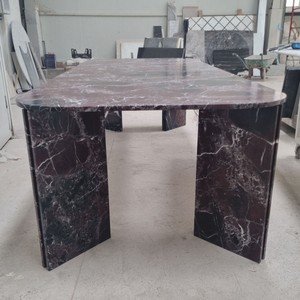
- Black marble with white veining: graphic and high in contrast, strong in restaurants, bars and dark bathrooms. Polished, it shows fingerprints, limescale and dust more clearly than pale stone.
- Travertine: warm beige to walnut tones with natural pores. For table tops and vanities the pores are usually filled and the surface honed. Travertine feels calm and Mediterranean and pairs well with timber, linen and brass.
- Onyx: translucent with a cloudy pattern and suitable for backlighting. Onyx is softer and more delicate than classic marble and belongs on feature surfaces, such as a bar front or a console, rather than on a heavily used table top.
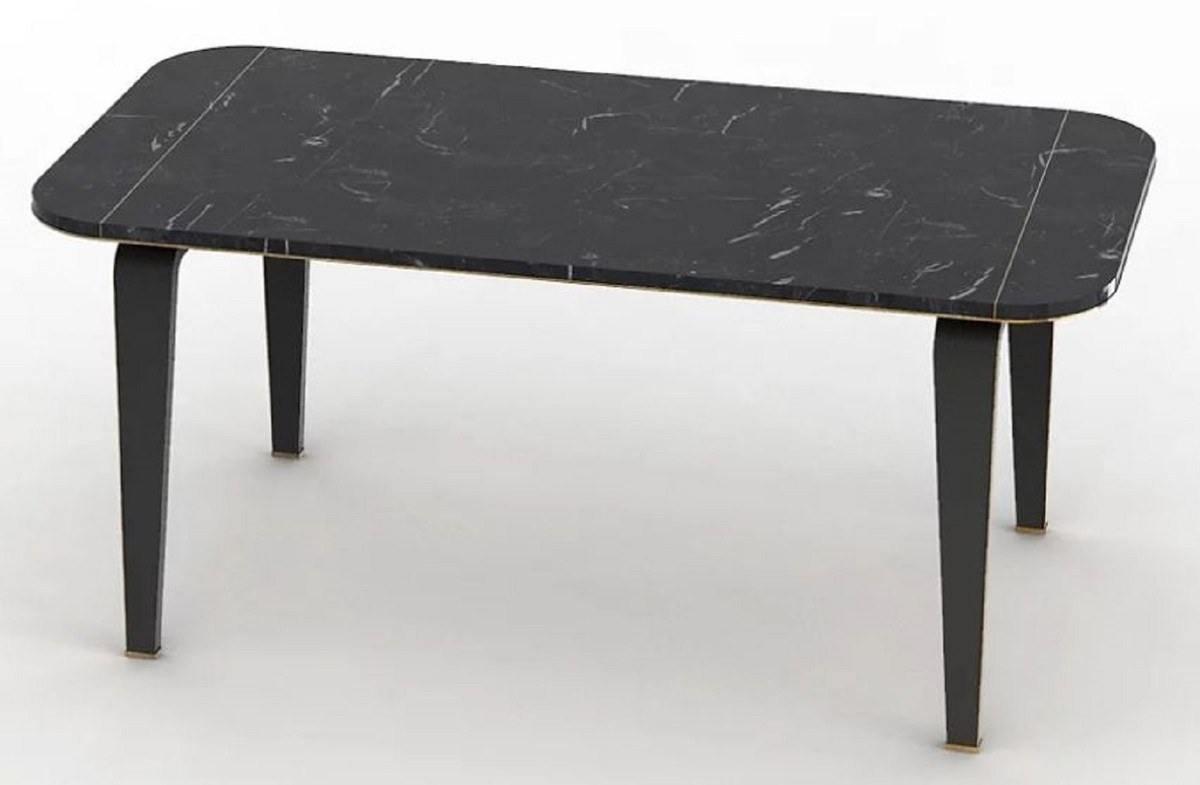
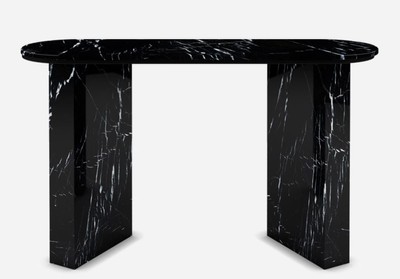
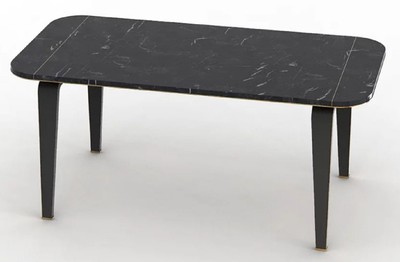
Black marble with white veining and brass details gives a restaurant a clear focal point. Pictured: Casa Padrino luxury dining table black / brass 180 x 90 x H. 80 cm
Finishes: polished, honed or brushed
The finish shapes the look and the everyday performance at least as much as the stone itself. A polished finish brings out colour and veining most strongly and reflects light. The gloss, however, also reveals every dull mark left by acids such as lemon, vinegar or wine. Polished surfaces suit consoles, vases, busts and coffee tables that rarely come into contact with food and drink.
A honed finish is matt, calmer and softer to the touch. Minor wear is barely visible and can be reworked on site by a stonemason. For restaurant dining tables and for vanities, honed marble is often the more practical choice. A brushed finish gives the surface a slight, tactile texture reminiscent of leather. It is the most forgiving and suits fountains, outdoor pieces and surfaces that are touched a lot.
Slab thickness and weight in planning
Marble weighs around 2.7 tonnes per cubic metre, which gives simple reference values for early planning. A 2 cm slab weighs about 54 kg per square metre, a 3 cm slab about 81 kg. A table top of 180 x 90 cm therefore comes to roughly 87 kg at 2 cm and roughly 130 kg at 3 cm, base not included. Solid consoles, fountains and large vases quickly reach several hundred kilograms; we state the exact weight of each piece in the quotation.
In practice this means checking floor loading, especially in older buildings and for fountains on upper floors. Lift capacity and car dimensions, stair widths, door openings and turning space all belong in the logistics plan. Where a slab looks particularly thick, the edge is often built up with a mitred apron, so it appears heavier than its core. This saves weight without changing the effect.
Stain protection and sealing
Marble is a porous calcareous stone. A penetrating sealer fills the pores and slows down how quickly oil, red wine, coffee or cosmetics soak in. It does not make the stone immune, but it buys time to wipe up spills before they become stains. It does not protect against acid: citrus juice, vinegar, wine and descaling cleaners attack the surface and leave dull etch marks whether the stone is sealed or not.
A simple test shows whether the protection is still working. A drop of water should sit on the surface for several minutes without darkening the stone. If it darkens, the sealer needs renewing. As a guide, heavily used restaurant tables need resealing every few months, while consoles, coffee tables and private dining tables usually need it about once a year.
Maintenance in hotel operation
In a hotel, housekeeping decides whether marble still looks good after years of service. A short care sheet in the team's documentation with a few clear rules has proved its worth:
- For daily cleaning, use only pH neutral stone cleaner or clear water with a soft cloth, then wipe dry.
- No vinegar, citrus or descaling products, no abrasive cleaners, no cloths with an abrasive layer.
- On vanities, dry off water and limescale after cleaning; place soap dispensers and toiletries on a tray.
- Provide coasters for glasses and bottles on dining and coffee tables, especially for wine and juices.
- Blot spills immediately rather than rubbing them in; leave stubborn cases to a stone care specialist.
Consoles, vanities and fountains: installation notes
Narrow, tall console tables in public areas are fixed to the wall so that nobody can tip them by leaning or pulling. For vanities we clarify in advance whether the tap comes from the wall or the top, where tap holes sit, whether an overflow is required and where the waste outlet is. Freestanding basins need a floor drain in exactly the right position, which must be fixed before the screed goes in.
Fountains need a load bearing base, power for the circulation pump and, depending on the model, a water supply. Outdoors, frost protection is part of the plan: drain the water, remove the pump, cover the basin. Vases and busts are best placed on a stable plinth in lobbies and stairwells and secured against tipping wherever children or many people pass.
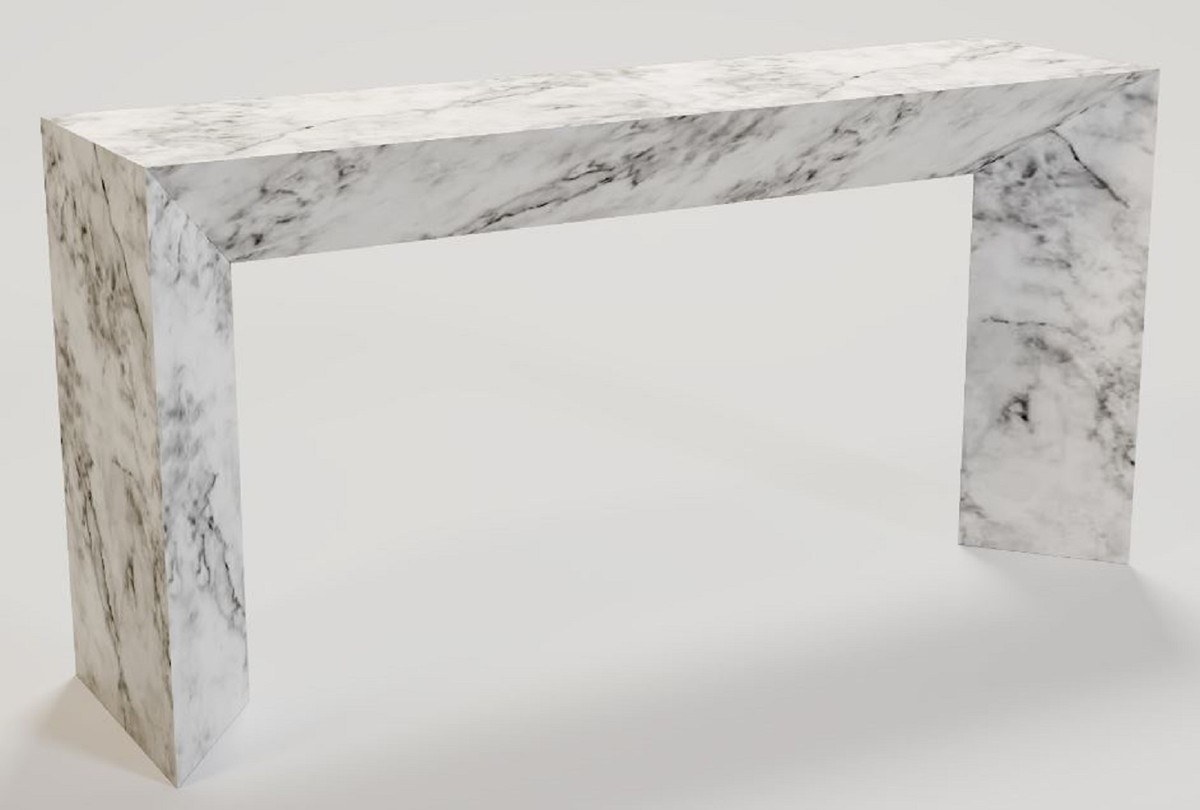
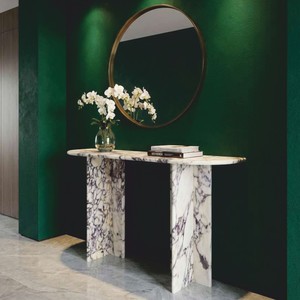
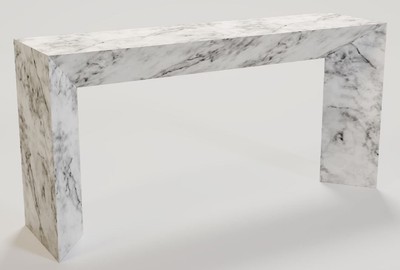
A Carrara marble console in a clean block form suits entrance halls, corridors and lift lobbies. Pictured: Casa Padrino luxury marble console white 160 x 42 x H. 80 cm
For architects and specifiers: samples, drawings, quantities
Natural stone is unique. Every slab differs in ground colour, veining and pattern, even within the same stone type. To align with the client or operator, a sample approval makes sense: we provide samples of the stone type on request so that colour, finish and feel can be judged in the light of the actual building. If many identical pieces are planned, such as vanities for every room on a floor, we discuss early on how consistent the slabs can be.
For dimensional planning, floor plans, elevations or sketches with the key measurements are enough, ideally as PDF or DWG. For each piece we provide overall dimensions, slab thickness, weight and, where needed, holes and cut outs, so you can transfer the data straight into your drawings. Quantities range from a single piece to complete floors. We align the delivery date with progress on site, in phases if required, so that stone does not sit on site for weeks. Throughout, you deal with one contact person for the whole project.
How we work with design studios and dealers is described on the page for architects and dealers. Furnished properties are shown in our hotel references.
Your marble enquiry in five steps
- Enquiry with dimensions and plans: you send floor plans, required sizes, quantities and the target date.
- Selection and samples: we propose suitable pieces, stone types and finishes; samples on request.
- Quotation: you receive a quotation with dimensions, weights and lead time, priced according to your project.
- Production: once approved, the pieces are produced, made to measure items according to the agreed drawings.
- Delivery: the goods are securely packed and shipped by freight forwarder to your address, worldwide, timed to the site schedule.
Frequently asked questions about marble in projects
Which marble is best for a restaurant dining table?
For tables in heavy use, honed marble with a good sealer has proved reliable. Dark or strongly veined stones hide marks better than pure white. If you want Carrara white, plan for coasters and regular resealing.
How heavy is a marble slab?
As a guide, marble weighs about 54 kg per square metre at 2 cm and about 81 kg at 3 cm. A 180 x 90 cm top therefore weighs between roughly 87 and 130 kg. The exact weight of every piece is stated in the quotation.
Does sealing prevent all stains?
No. It slows the absorption of oil, wine and coffee but does not protect against acid. Citrus, vinegar and descaling cleaners leave dull marks even on sealed marble.
Can tables and consoles be made to measure?
Yes, many pieces can be produced to your dimensions on request, including different slab thicknesses or stone types. What is possible in each case is clarified with your drawings.
Can I see a sample of the stone first?
Samples of the stone type are available on request. Because natural stone varies from slab to slab, a sample shows ground colour, finish and character, not the exact veining of the final piece.
Is marble suitable for hotel vanities?
Yes, provided finish and maintenance are right. A honed surface, a good sealer and housekeeping without descaling products keep marble vanities attractive for years.
Request your marble project
Send us plans, dimensions and quantities. We will come back to you with a proposal for stone type, finish and execution, together with a quotation tailored to your project.
Email: info@casa-padrino.de · Phone: +49 212 14912917
More trades for your project
- Bronze sculptures
- Sculptures for hotels and gardens
- Marble fireplace surrounds
- Fireplaces for hotels
- Marble columns
- Bathtubs for hotel bathrooms
- Consoles and side tables
- Garden furniture for hotels and resorts
Venues and sectors
- Hotel Room Furniture
- Hotel Sofas and Hotel Armchairs for Lobbies
- Bar Counter for Hospitality
- Lounge and Club Furniture for Bars and VIP
- Executive Office Furniture
- Beauty Salon Furniture
- Wedding Throne Chair
- Window Display Decoration for Malls and Retail
- Life-Size Fiberglass Statues for Theme Parks
- Christmas Market Decorations